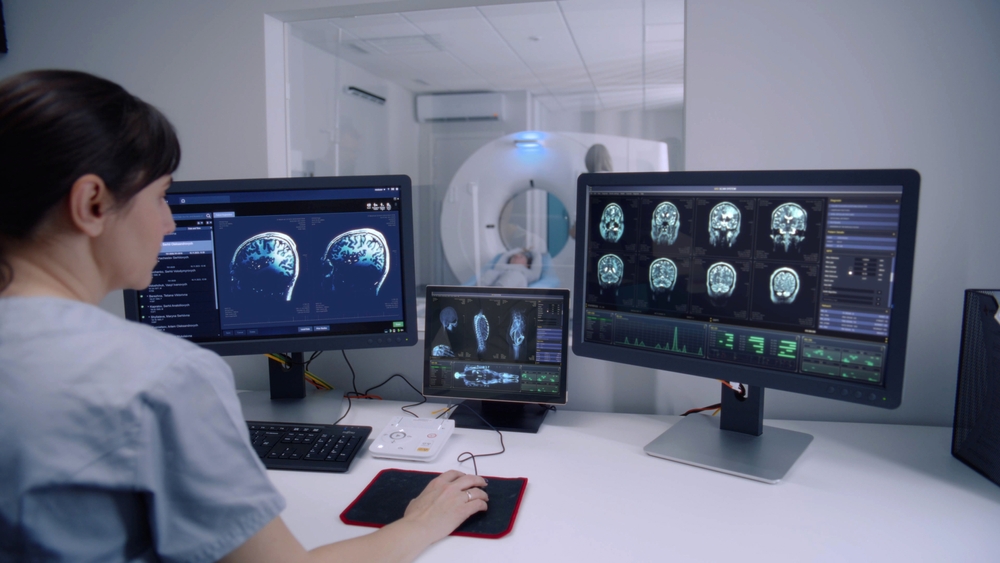
For many practices considering in-house PET imaging, the biggest obstacle is financial risk.
A fixed PET-CT installation requires major upfront investment:
- Shielded construction
- Equipment procurement
- Staffing expansion
- Regulatory and accreditation work
All before generating a single dollar of imaging revenue.
Mobile PET-CT offers a lower-risk path forward. Practices can begin scanning, generating revenue, and validating patient demand before committing to permanent infrastructure.
Instead of relying on projections alone, providers gain real operational and financial data to support a future fixed-site decision.
What “Mobile” Actually Looks Like at a Partner Site
Many providers assume mobile PET-CT means a shared unit rotating between multiple facilities on a limited schedule.
For most Captive Radiology partners, that is not the case.
Dedicated. Parked. Integrated Into Your Practice.
Most partner sites operate with a PET-CT unit permanently stationed at their facility and dedicated exclusively to their patients and schedule.
In many cases, “mobile” simply describes how the system was originally deployed, not how it functions day to day.
Why This Distinction Matters Financially
How a unit is deployed directly impacts how much revenue a practice can generate from it.
A routed, shared unit limits scan volume to the days it is physically onsite. A permanently parked unit gives practices:
- Full scheduling control
- Consistent weekly capacity
- Improved patient convenience
- Greater operational flexibility
That consistency creates a stronger foundation for long-term imaging growth.
Why Practices Start With Mobile PET-CT
1. Lower Upfront Financial Exposure
Mobile deployment dramatically reduces initial capital requirements compared to fixed construction.
Practices can often begin scanning within weeks instead of waiting through a lengthy construction timeline.
Mobile vs. Fixed PET-CT Timeline Comparison
Mobile PET-CT
- Faster deployment
- Lower upfront costs
- Immediate imaging revenue
- Real-world demand validation
Fixed PET-CT
- Construction and shielding
- Higher capital investment
- Longer operational ramp-up
- Permanent infrastructure commitment
2. Real Revenue Data Before Permanent Investment
During the mobile phase, practices gather:
- Actual scan volume
- Real reimbursement performance
- Referral pattern data
- Workflow and staffing insights
This creates a far more accurate financial model than relying on market averages or projections alone.
“Mobile PET-CT turns projected ROI into measurable operational proof.”
3. A Smarter Fixed-Site Decision
When demand consistently supports expansion, the decision to build fixed imaging becomes far less speculative.
The investment is supported by proven performance from the practice’s own patient population and referral network.
How Practices Transition From Mobile to Fixed Imaging
The mobile-to-fixed pathway is not theoretical. Multiple Captive Radiology partners have successfully used mobile PET-CT to validate demand before expanding into permanent installations.
Central Ohio Urology Group: From Mobile to Fixed
Central Ohio Urology Group operated PET/CT through a mobile scanner for nearly three years before transitioning to a fixed in-house installation.
The mobile phase allowed the practice to:
- Validate patient demand
- Build operational confidence
- Establish consistent scan volume
- Evaluate long-term financial performance
After proving the model successfully, the practice expanded into a fixed scanner capable of supporting both PET/CT imaging and CT simulation for its Radiation Therapy team.
The result was expanded clinical capability, greater operational control, and a renewed six-year partnership.
First Urology: Choosing the Right Operational Partner
First Urology followed a different path. After deciding to bring PSMA imaging in-house, the group evaluated multiple imaging partners before selecting Captive Radiology.
The decision extended beyond equipment alone. Operational support, staffing, compliance management, and implementation experience all played a role in protecting long-term ROI.
Financial projections matter. Execution matters just as much.
Why PET-CT Creates Strong ROI in Urology
The financial opportunity for in-house PET-CT is especially strong in urology practices because clinical value and operational efficiency align closely.
Better Imaging Supports Better Care
PSMA PET-CT identifies metastatic prostate cancer more accurately than conventional CT and bone scan imaging.
That improved precision can directly influence treatment planning, care coordination, and patient management decisions.
Three Financial Benefits From One Imaging Program
Bringing PET-CT in-house can help practices:
- Retain imaging revenue that would otherwise leave the organization
- Reduce patient attrition between referral and completed scan
- Accelerate diagnosis and treatment planning workflows
The result is stronger continuity of care alongside improved operational performance.
Retain Revenue
Keep imaging revenue in-house
Reduce Attrition
Fewer patients lost between referral and scan
Accelerate Care
Faster diagnosis and treatment planning
What To Evaluate Before Choosing a Mobile PET-CT Partner
Not all mobile PET-CT programs operate the same way. Before committing, practices should evaluate several operational and financial factors.
Dedicated vs. Routed Deployment
Is the unit assigned exclusively to your facility, or shared across multiple locations?
Equipment Generation
Newer systems typically provide better image quality, improved reliability, and fewer service interruptions.
Staffing Support
Confirm whether technologist staffing is included and how the program handles coverage gaps.
Fixed-Site Expansion Experience
A qualified partner should be capable of supporting both mobile and permanent imaging strategies.
Regulatory and Compliance Support
Licensing, accreditation, and state-specific requirements can create a significant administrative burden if not properly managed.
Your imaging partner should own this process, not shift it onto your internal team.
Mobile First. Fixed When Proven.
Mobile PET-CT provides a lower-risk way to evaluate demand, generate imaging revenue, and build the operational data needed for long-term expansion.
For some practices, mobile remains the right long-term solution. For others, it becomes the foundation for a future fixed-site installation.
3-Step Imaging Growth Journey
Step 1: Launch Mobile PET-CT
↓
Step 2: Validate Volume, Revenue & Demand
↓
Step 3: Expand to Fixed Imaging When Proven
Either way, the goal remains the same: Build a financially sustainable imaging program that supports timely diagnosis, strong patient care, and long-term practice growth.
Captive Radiology helps partners navigate both mobile and fixed imaging strategies with operational support designed for long-term success.
Ready to Evaluate Your PET-CT Strategy?
Contact Captive Radiology to discuss whether a mobile, fixed, or phased approach makes the most sense for your practice.